Science Olympiad — Current Season Topics
Current Season Topics
Chemical Reactions/Stoichiometry + Kinetics
Scroll down to see details
Chemical Reactions/Stoichiometry
6. Balancing Chemical Equations
-
Empirical and Molecular Formulas
-
Limiting and Excess Reactants
Stoichiometry is the study of relationships between the relative quantities of substances that are involved in a reaction.
-
Avogadro's Number; A numeric value that measures the number of particles (atoms, molecules, etc.) that are in 1 mole of an element.
-
Moles; A stoichiometric unit of measurement that represents a specific quantity of of a substance using the Avogadro's number.
-
Mole Ratios; The ratios of moles of each substance in a balanced chemical equation that is used for stoichiometric conversions.
-
Limiting Reactant; The reactant in a reaction that goes to completion before the other reactant(s), indicating the maximum amount of substances that can react and form.
-
Excess Reactant; The reactant(s) that is/are larger in quantity than the limiting reactant, so some will be left over once the reaction has gone to completion.
-
Theoretical Yield; The maximum theoretical amount of products that the reaction can produce.
-
Percent Yield; The ratio of the theoretical yield to the actual yield represented as a percentage.
-
Percent Error; How far the measured value is compared to the theoretical value shown as a percentage.
-
Molarity; A quantitative representation of how concentrated a solution is.
-
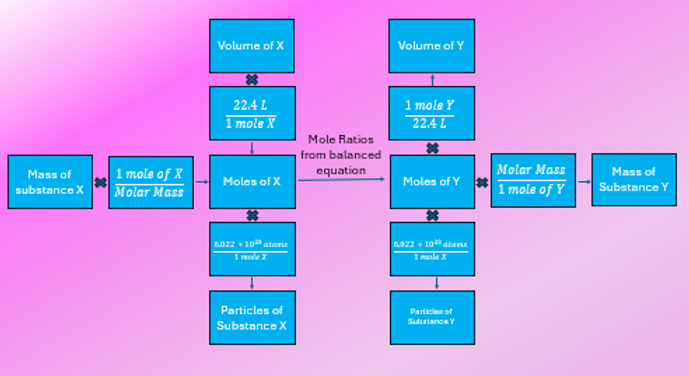
The Stoichiometry Conversion Chain:
-
Percent Yield Formula:
-
Percent Error Formula:
-
Molarity Formulas
% Yield =
x 100%
% Error =
Molarity =
Below is a list of the Polyatomic Ions you are required to know for Chemistry Lab
-
Nitrate Ion:
-
Carbonate Ion:
-
Phosphate Ion:
-
Acetate Ion:
-
Sulfate Ion:
-
Ammonium Ion:
-
Bicarbonate Ion:
-
Hydroxide Ion:
There are 5 types of chemical reactions you should know for Chemistry Lab.
- Synthesis/Combination Reaction
2 simple compounds (elements or substances) join together to create only 1 larger product, thus it's called a synthesis reaction. Combining substances releases energy, thus, most synthesis reactions are exothermic, however, some do require energy input.
A + B --> AB
- Decomposition Reaction
The opposite of a synthesis reaction, where 1 complex substance decomposes into 2 separate simpler products. Breaking bonds requires energy, thus, most decomposition reactions are endothermic.
AB --> A + B
- Combustion Reaction
A combustible substance (most often a hydrocarbon or carbohydrate) reacts with Oxygen gas to form Carbon Dioxide and Water.
Hydrocarbon/alcohol +
- Single - Replacement Reaction
A type of chemical reaction where a single element replaces another element in a compound. Usually, the more reactive metal replaces the less reactive metal, and the same goes for a situation involving nonmetals. Remember, in a single-replacement reaction, a metal always has to be bonded to a nonmetal, and the other product is an unbonded element on its own.
AB + C --> AC + B
- Double - Replacement/Metathesis Reaction
In a Double-replacement/Metathesis reaction, two ionic compounds switch partners. The cation of one substance will pair with the anion of another substance within the reaction. The reaction will proceed only if one of the products forms a solid, a gas, or water.
AB + CD --> AC + BD
-->
There are several different ways to balance a chemical equation. Below are some of the most common ways. Click on see more to learn about each!
What is it?
Empirical Formula is the most simplified whole-number ratio of molecules in a compound, while Molecular Formula is the exact number of molecules in a compound.
For example, Hydrogen Peroxide's Molecular Formula is , but it's empirical formula becomes HO
Below is a step-by-step tutorial of how to find the Empirical Formula of a compound from percent composition using C, H, and O as an example:
-
Given that the percent composition of the compound is 40% C, 6.71% H, and 53.29% O
-
Always assume the % composition is taken from an 100g. sample, so 40% C becomes 40g. C
-
Convert the masses into moles separately;
-
3.33 moles of C
-
6.66 moles of H
-
3.33 moles of O
-
Find the element with the smallest number of moles, in this case it's either C or O (3.33 moles)
-
Divide the moles of each element by the smallest number of moles
-
3.33 moles of C/3.33 moles = 1 mole of C
-
6.66 moles of H/3.33 moles = 2 moles of H
-
3.33 moles of O/3.33 moles = 1 mole of O
- Use the simplified mole ratios as subscripts in the final chemical formula!
Formula for the above example:
Using the same example, let's find the Molecular Formula for the same compound:
-
Given the Empirical Formula is
-
Given that the experimentally measured molar mass is 60.052g.
-
Obtain the empirical mass by adding the mass of all elements in the Empirical Formula
C + H + H + O = 12.01g. + 1.008g. + 1.008g. + 15.999g. = 30.026g.
- Divide the molar mass by the empirical mass to find "n"
-
60.052g./30.028g. = 2
-
n = 2
- Multiply the subscripts of elements in the Empirical Formula by "n"
2 ( ) =
- Congratulations! You now have successfully found the Molecular Formula!
Molecular Formula =
There are two great ways to solve problems relating to Limiting and Excess reactants. Both versions here will use the following balanced chemical equation as an example:
Version #1: Convert using mole ratios:
-
Given that there are 4.0 moles of Hydrogen gas and 3.0 moles of Oxygen gas
-
Convert moles of each reactant into moles of products separately using mole ratios:
-
4.0 moles x = 4.0 moles
-
3.0 moles x = 6.0 moles
- Compare the two results, find the least number of moles, and the corresponding reactant will be the Limiting Reactant:
In this example, is the Limiting Reactant.
Version #2: Using a BCA Table:
Kinetics
4. Factors Affecting Reaction Rates
5. Collision Theory and Reaction Progression Graphs
Kinetics is the study of how fast a reaction proceeds to completion, and the factors that affect the rate of reactions.
-
Activation Energy; The minimum amount of energy required for a reaction to proceed in either the forward or reverse direction.
-
Catalysts; A substance that speeds up the reaction by lowering the activation energy without being consumed in the reaction itself.
-
Effective Collision; The collision between molecules that has enough potential to lead to a chemical reaction.
-
Rate of Reactions; The measure of the speed in which reactants are converted into products in a chemical reaction.
-
Rate Constant (k); A number that relates the rate of a chemical reaction to the concentration of the reaction. Indicates how fast a reaction will proceed under different circumstances, such as pressure or temperature. Larger "k" values indicate faster reactions while smaller "k" values indicate slower reactions. The most common units of "k" is listed below:
-
Reaction Order; The reaction order shows how the rate of a reaction is affected by the concentration of each reactant. It is found by looking at the exponents in the rate law, and it tells you how changing a reactant’s concentration changes the reaction rate.
-
Overall Reaction Order; The sum of all the individual reaction orders (defined above).
-
Sufficient Energy; The minimum energy required for a reaction to occur.
9. Differential Rate Law; Expresses the relationship between the variations in the concentrations of the reactants to the overall reaction rate.
-
Reaction Mechanisms; A series of elementary steps/elementary reactions (a set of steps a reaction goes on) that together represents the overall progress of a chemical reaction.
-
Reaction Intermediates; Species that appear in a reaction mechanism but not the overall balanced reaction. It is formed in one elementary step and consumed in a later step.
-
The Rate Law (general formula):
rate = , where "x" is the reaction order with respect to element A, and "y" is the reaction order with respect to element B.
- Units of the rate constant (k):
If rate = ,
n = 1: rate = k[A] = 1/s
n = 2: rate = = 1/(s) x (M) = (L) x (mol-1) x (s-1)
n = 3: rate = = 1/(s) x (M2) = (L2) x (mol-2) x (s-1)
Below are the 5 factors that affects reaction rates.
-
Temperature; As temperature increases, the reaction usually speeds up due to the increase in kinetic energy, thus, molecules collide with each other more energetically and more frequently, increasing the number of effective collisions.
-
Concentration; As the concentration increases, reaction rate becomes higher due to more molecules being present which are able to produce more frequent effective collisions.
-
Catalyst; A catalyst lowers the activation energy of a reaction, so the reaction rate increases in speed because it's able to proceed with less required circumstances.
-
Surface Area; As surface area increase, there are more opportunities for effective collisions to occur because there are more area that molecules can collide with.
-
Pressure of gaseous substances; When pressure increases, reaction rate also increases because the molecules are closer together, thus, they will collide into each other more frequently, leading to a higher rate of effective collisions.
Collision Theory: A model in kinetics that explains how and when a chemical reaction occurs.
There are 3 requirements to the Collision Theory, and all of which must be true for a reaction to occur. In order for molecules to react, they must collide:
-
Into another molecule
-
With sufficient energy
-
In proper orientation
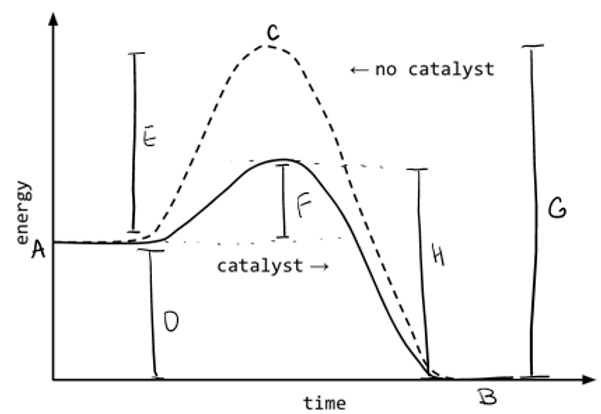
- A: Potential Energy of Reactants
A: Potential Energy of Reactants
- B: Potential Energy of Products
B: Potential Energy of Products
- C: Potential energy of activated complex
C: Potential energy of activated complex
- D: Heat of Reaction (change in enthalpy)
D: Heat of Reaction (change in enthalpy)
- E: Activation Energy of forward reaction (uncatalyzed)
E: Activation Energy of forward reaction (uncatalyzed)
- F: Activation Energy of forward reaction (catalyzed)
F: Activation Energy of forward reaction (catalyzed)
- G: Activation Energy of reverse reaction (uncatalyzed)
G: Activation Energy of reverse reaction (uncatalyzed)
- H: Activation Energy of reverse reaction (catalyzed)
H: Activation Energy of reverse reaction (catalyzed)
Before we determine the Rate Laws, let's first learn the reaction orders and what they mean:
Zero order ( ); The rate of the reaction will NOT change regardless of the amount of reactants present, essentially meaning that the rate will remain the same even if the concentrations of the reactants are changed.
First order ( ); The rate of reaction in this case is DIRECTLY PROPORTIONAL to the concentration of the reactant. So if the concentration doubles, the rate of reaction also doubles, etc.
Second order ( ); The rate of reaction is proportional to the SQUARE of the concentrations. If the concentration doubles, the rate of reaction quadruples, etc.
Now, there are 3 things you need to keep in mind as you solve questions relating to Kinetics:
-
Rate laws are ALWAYS determined from experiments.
-
Reaction orders are NEVER defined using the concentration of the products. It's always with respects to the concentrations of the reactants.
-
The reaction orders are NOT the same as, and therefore, NOT related to the coefficients in a balanced chemical equation unlike equations used in Equilibrium. It is always obtained through experimental data.
Finally, let's work through how to determine the rate law using the following hypothetical experimental data as an example:
In this specific example, it's easy to spot that from trial 1 to trial 2, the concentration of A doubles while B remains the same, and the rate doubled. This means that the reaction is First Order with respect to element A.
Then, looking at trials 1 and 3, the concentrations of B doubles while A remains the same, and the rate quadruples. This means that the reaction is Second Order with respect to element B.
So, the complete Rate Law equation for this reaction would be:
However, it's not always so easy to determine the reaction orders due to ridiculous numbers such as those in scientific notation. So, in general, here's a step-by-step guide to determining rate laws that will always work, and this example uses the same experimental data as above:
- Find two trials where one element's concentration changes while the other remains constant.
In this case we will first look at trials 1 and 2.
- Plug in the numbers into the Rate Law general formula:
rate =
(Trial 1) 0.01 =
(Trial 2) 0.02 =
- Solve the equation like a system of equations problem, and use division to cancel out the terms (tip: put the trial with larger numbers on top for simplicity):
2 =
-
Solve the simplified equation using exponential properties. In this example, x = 1. This means that the reaction order is 1 with respect to element A.
-
Repeat the process to find the reaction order for element B. We will compare trials 2 and 3 this time (tip: you should be plugging in the known reaction order that you just found, in this case it's first order with respect to element A, to make the equation simpler):
(Trial 3) 0.04 =
0.5 = 2
0.25 =
y = 2
Since now we know the individual reaction orders for both elements, we can use what we know to solve for the rate constant (k) and apply the correct units.
The easiest way to do so would be to plug in the values of any one trial into the rate law equation and use isolation method to solve for the value of k. The process below will use Trial 1:
0.01 =
k = 0.01 / 0.000000064
k = 156250
Finally, we can write the complete rate law for this reaction, and find the overall reaction order.
rate = 156250
Overall reaction order = 1 + 2 = 3

Integrated Rate Laws are mathematical equations in chemical kinetics that relates the concentration of reactants to time, and can determine concentrations at any point in a reaction. Unlike differential rate laws (gives instantaneous rate), integrated rate laws helps determine reaction progress, calculate half-life, and know how fast a reaction is occurring over time.
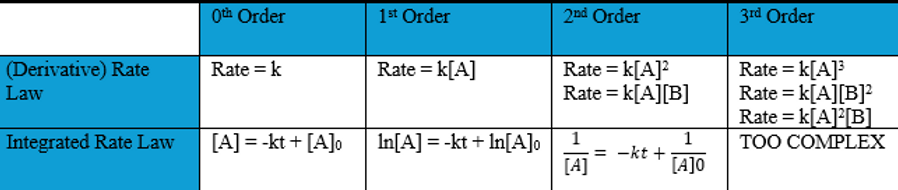
/ [A]0 = Initial concentration of reactant A, expressed in Molarity (M)
[A] = Concentration of the reactant A at given t, expressed in Molarity (M)
Half-life is the measure of the time it takes for half of the given amount of reactants to fully decay or react.
It follows an exponential decay pattern, meaning that as concentration decreases, the rate of decay also slows.
Here are the half-life equations following the order of the rate laws: